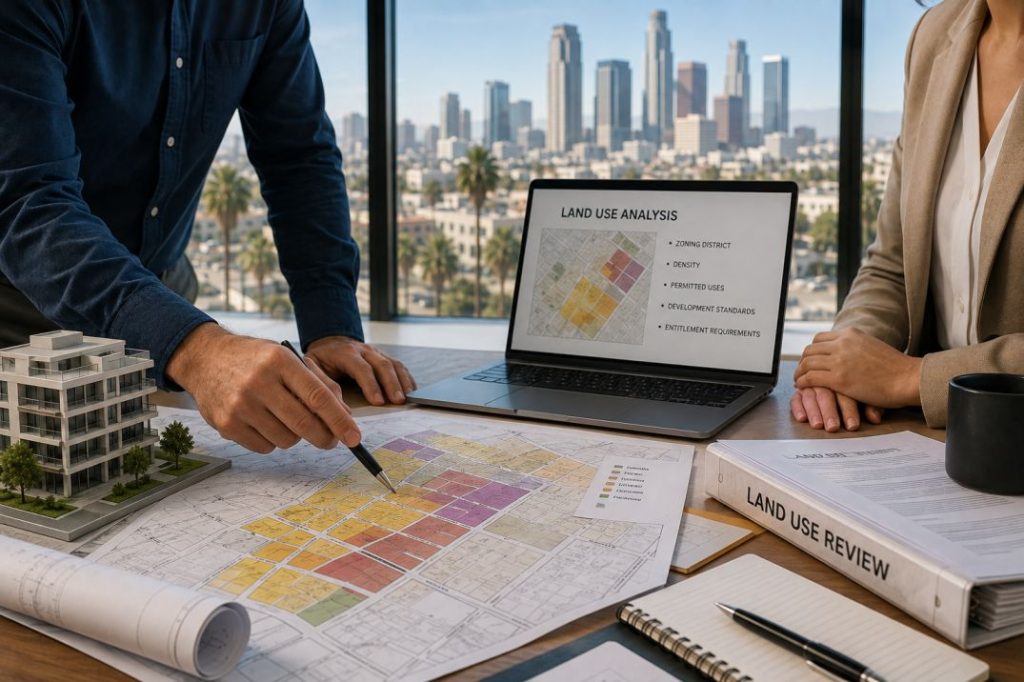
Developing property in Los Angeles involves more than deciding what you want to build. Before a project can move forward, property owners and developers need to understand zoning, land use rules, development standards, approvals, and other requirements that may affect the site.
This is where a land use consultant can help.
A land use consultant helps clients understand how a property can be used and developed under current regulations. They can also help identify approval requirements, development opportunities, and potential problems before a project reaches the design or construction stage.
For property owners, investors, and developers, getting this guidance early can save time, reduce risk, and lead to better development decisions.
A land use consultant works with property owners and development teams to evaluate how land can be used under applicable regulations and planning policies.
Their work may involve reviewing zoning, development standards, planning documents, overlay districts, and proposed project uses.
Depending on the project, a land use consultant may help with:
The exact role depends on the property and the proposed development.
Los Angeles properties are subject to zoning and land use requirements that can affect what owners are allowed to build or operate.
Two properties located close to each other may have very different development opportunities because of their zoning, lot size, overlay districts, development standards, or other site conditions.
Before purchasing or developing property, it is important to understand these factors.
A land use review can help answer basic questions such as:
These answers can have a direct impact on the value and feasibility of a property.
The role can vary from project to project, but land use consultants often work between the property owner, design team, planning agencies, and other professionals involved in development.
They may begin by reviewing the property’s existing zoning and land use designation. From there, they can identify development standards and approval requirements that may affect the proposed project.
For a more complex development, the consultant may also help develop an entitlement strategy and coordinate with the appropriate agencies.
The goal is to give the project team a clear understanding of the land use issues before major decisions are made.
The best time to involve a land use consultant is often before significant money is committed to the project.
This can mean hiring one before purchasing a property, before finalizing a development concept, or before beginning detailed construction plans.
Early involvement gives you more flexibility.
A consultant can identify potential restrictions while there is still time to change the project approach, negotiate a purchase, adjust the development concept, or pursue the required approvals.
Waiting until plans are nearly complete can make land use problems more expensive to solve.
One of the most useful times to hire a land use consultant is during property due diligence.
A property may appear attractive based on its location, size, or purchase price. But its development potential may be limited by zoning or other regulations.
Before purchasing, a consultant can help evaluate:
This information can help investors determine whether the property supports their intended use.
It may also reveal development opportunities that are not obvious from the current use of the property.
Land use consulting can also be valuable when a development concept is already being considered.
For example, an owner may want to build additional residential units, convert an existing property, develop a commercial site, or pursue a mixed-use project.
The consultant can review the proposed use against the applicable land use rules and identify what approvals may be needed.
This allows the development team to create plans around realistic requirements rather than discovering major restrictions later.
Some projects cannot move forward under the property’s existing zoning and require additional approvals.
Depending on the circumstances, these may include:
A land use consultant can help determine which approvals may apply and develop a path for pursuing them.
This is particularly important for projects where the proposed use or development intensity does not fit within the property’s existing regulations.
Land use problems can become expensive when they are discovered late.
A project may require redesign, additional studies, new approvals, or changes to the development concept. In some cases, a proposed use may not be feasible under the existing regulations.
Early land use analysis helps identify these issues before substantial design and construction costs are incurred.
It can also help owners compare different development options and choose an approach that makes better use of the property.
Land use consulting is not only about finding restrictions.
A careful review can also uncover opportunities.
For example, a property may have potential for additional units, a different permitted use, a subdivision, or another development strategy that an owner has not considered.
State housing laws, local regulations, overlay districts, and changes to planning policies can also affect what may be possible.
Understanding the full regulatory picture allows owners and investors to evaluate a property based on its potential rather than only its current condition.
Land use consultants often work closely with architects, engineers, developers, and other project professionals.
An architect may have a strong design concept, but that concept still needs to work within the property’s land use requirements.
A land use consultant can help identify restrictions before the design becomes too far along.
This coordination can reduce unnecessary revisions and give the design team a clearer framework to work within.
Not every project requires the same type of experience. When choosing a consultant, consider their knowledge of the local planning process and experience with projects similar to yours.
Look for someone who understands:
It is also important that the consultant can explain complex planning issues in clear terms.
You should understand what the consultant found, what it means for your property, and what steps may be needed next.
The cost depends on the property, project type, and level of analysis required.
A basic zoning review may require less work than a complex development involving multiple approvals, agency coordination, and entitlement planning.
Before starting, ask the consultant to explain the scope of work and what is included.
The right scope depends on what you are trying to determine. A property owner considering a purchase may need a different level of analysis than a developer preparing a large project for approval.
Real estate development decisions can involve significant amounts of time and capital. Understanding the land before committing to a development strategy is therefore an important part of due diligence.
A land use consultant can help you determine whether your plans fit the property, identify potential obstacles, and evaluate alternative approaches when they do not.
That information can be useful before buying a property, preparing construction plans, hiring consultants, or submitting applications.
Land Works Consulting provides land use consulting services for property owners, investors, developers, architects, and other project professionals throughout Los Angeles.
Our work includes zoning and land use analysis, development potential assessment, entitlement coordination, feasibility studies, permit expediting, pre-construction planning, and project management.
Whether you are evaluating a property before purchase or preparing an existing site for development, we help you understand the land use requirements that can affect your project.
The earlier these issues are addressed, the more options you have.
A real estate agent focuses on buying, selling, and leasing property. A land use consultant focuses on how property can be used and developed under applicable planning and zoning regulations. Their work can help investors understand development potential before making a real estate decision.
A consultant can review zoning, land use designations, development standards, and other applicable requirements to help determine what may be possible. The final approval of a project remains with the appropriate government agencies.
In many cases, yes. A land use review before purchase can help identify restrictions, approval requirements, and development opportunities that may affect the property’s value and your investment plans.
No. Simple projects may not need extensive land use consulting. However, professional guidance can be useful when a project involves complex zoning, a change of use, increased density, entitlements, or significant development investment.
Yes. Depending on the project, a land use consultant can help identify required entitlements, develop an approval strategy, coordinate documentation, and work with the project team and agencies throughout the process.
Land use rules can shape what is possible on a property long before construction begins. Understanding those rules early can help property owners and investors avoid costly mistakes and identify opportunities that may otherwise be missed.
If you are buying property, planning a new development, or considering changes to an existing site, a land use consultant can provide the information you need to make a more informed decision.
Land Works Consulting helps clients throughout Los Angeles understand zoning, land use, development requirements, and the approval process before moving their projects forward.
Get the latest development news, zoning updates, and strategic insights delivered directly to your inbox.